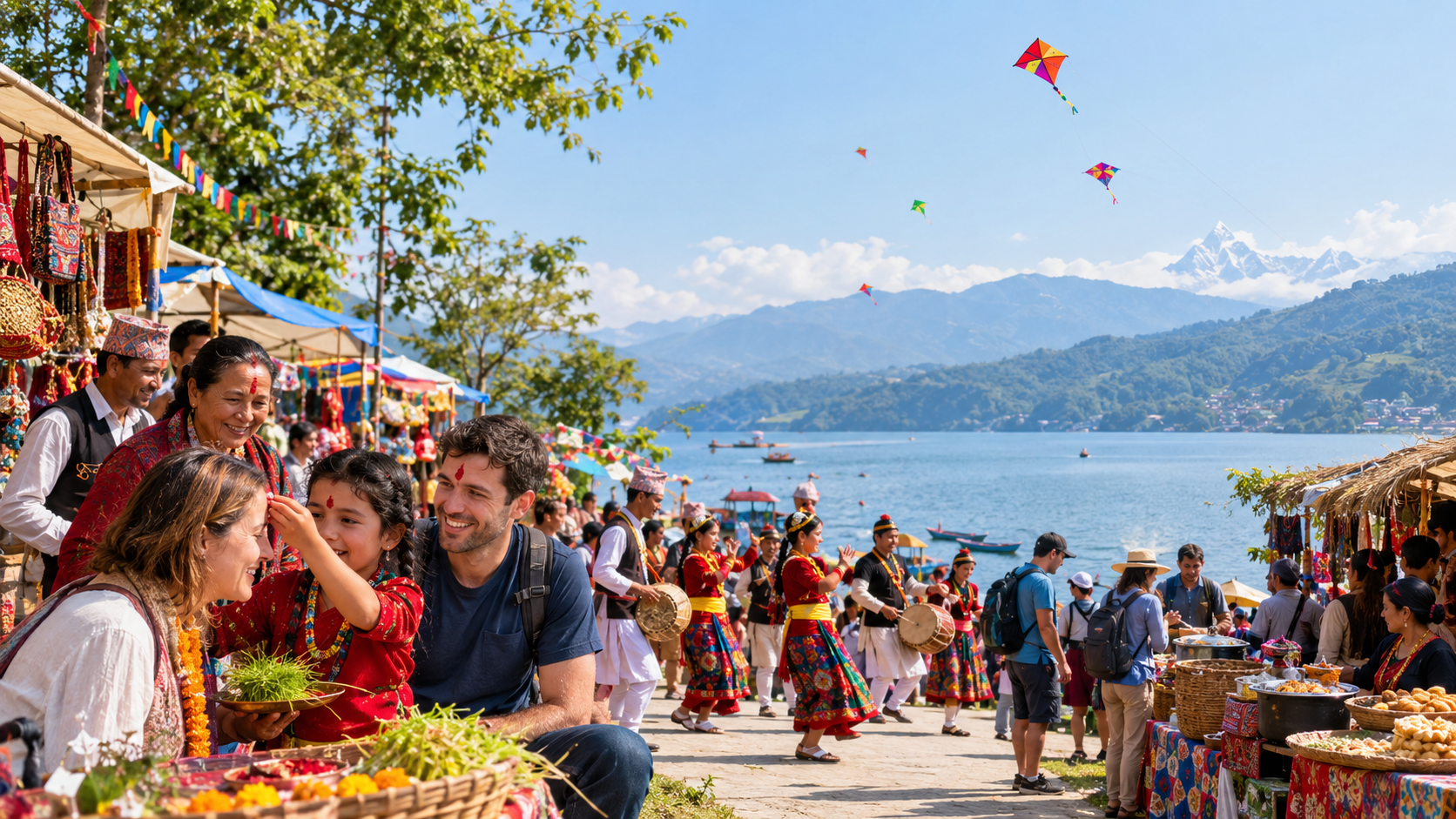
Nepal’s religious calendar is dense and varies by community, but several festivals bring Pokhara’s temples to life in ways that are visible and accessible to visitors who happen to be in town at the right time. Understanding what each festival involves — and which temples are at the centre of the activity — makes the difference between wandering into a crowd and understanding what you are watching.
Dashain: The Fifteen-Day Festival
Dashain is Nepal’s longest and most widely observed festival. It honours the goddess Durga and falls in the Nepali months of Ashwin and Kartik — usually late September through mid-October. In 2026, Dashain runs from October 11 to October 25, with the most significant days concentrated between October 17 and 23.
The festival follows a day-by-day structure, with specific rituals on each named day.
The Key Days
Ghatasthapana (Day 1): The festival begins with the installation of a sacred kalash (a clay pot representing the goddess) in a family prayer room, and the sowing of barley seeds. These seeds are tended for nine days, growing into golden shoots called jamara that become central to the Day 10 ceremony.
Fulpati (Day 7): Sacred flowers and plants are offered to the deity. This day involves processions and offerings at temples across Nepal. At Bindhyabasini Temple in Pokhara, Fulpati is one of the year’s most important days of worship.
Maha Ashtami (Day 8): Sacrificial offerings to Goddess Kali are made at temples on this night. The mood intensifies.
Maha Nawami (Day 9): The most intense day of Durga worship. Bindhyabasini Temple, dedicated to a form of Durga, is particularly active on this day. Weapons and tools are ceremonially blessed — a tradition connected to Durga’s role as a protector in battle.
Vijaya Dashami (Day 10): This is the emotional heart of Dashain. Elders apply tika — a red paste mark — to the foreheads of younger family members, along with the jamara shoots grown since Day 1. The blessing carries deep significance: it is an act of protection and transmission from one generation to the next. Families travel across Nepal and from abroad to receive tika from their elders on this day.
What Travelers Witness in Pokhara
During Dashain, Pokhara takes on a different character. Kite-flying is widespread — the sky above Lakeside and the old town fills with kites throughout the festival period, a tradition associated with the season. Bamboo swings (Linge Ping) appear in open fields and public spaces. Shops close for the major days. Buses fill with families returning home.
At the temples, the activity is genuine and not staged for tourism. Bindhyabasini Temple draws crowds for Fulpati and Maha Nawami. Tal Barahi Temple on Fewa Lake is active throughout Dashain, with daily pujas and offerings.
Visitors are generally welcome to observe from a respectful distance. Receiving tika is a family ritual — do not ask strangers for tika unless they offer; it is not a general tourist experience. If a local family invites you to join their celebration, accepting is a warm gesture, but follow their lead on customs.
Shivaratri: The Night of Shiva
Maha Shivaratri falls in late February or early March (the 14th night of the dark fortnight in the Nepali month of Falgun). It is a night of fasting and overnight worship dedicated to Lord Shiva.
In Pokhara, Bindhyabasini Temple is active during Shivaratri, and the Gupteshwar Mahadev Cave — a cave temple dedicated specifically to a natural Shiva lingam — draws particular attention. The cave’s religious identity as a Shiva site makes it one of the more meaningful places to observe Shivaratri in the valley.
The most famous Shivaratri celebration in Nepal is at Pashupatinath Temple in Kathmandu, which attracts enormous crowds including sadhus (wandering Hindu ascetics) from across South Asia. Pokhara’s observances are smaller in scale but more accessible and less crowded.
Teej: The Festival of Women at Shiva Temples
Teej falls in August or September (the Nepali month of Bhadra) and is observed primarily by Hindu women. The festival involves a day of fasting, traditional red dress, singing, and dancing — followed by visits to Shiva temples to offer prayers for the wellbeing of husbands and families.
Shiva temples are the focal point of Teej, which makes Gupteshwar Mahadev Cave and the Shiva shrine within Bindhyabasini Temple relevant sites during this period. The festival is vivid and photogenic — groups of women in red sari gather at temples throughout the day.
Note: While Teej at Shiva temples in general is well documented, specific activities at individual Pokhara temples during Teej have not been confirmed in sources accessed for this article. The section above describes the general festival; editors should verify local Pokhara specifics before final publication.
Tihar: Lakeside During the Festival of Lights
Tihar (also called Deepawali or Diwali) follows Dashain by approximately three weeks, falling in October or November. The five-day festival honours different beings on successive days — crows, dogs, cows, oxen, and brothers — and culminates in a night of oil lamps and colored-powder decorations (rangoli).
Tihar is less temple-specific than Dashain but transforms public spaces dramatically. Lakeside in Pokhara is notably festive during Tihar — lights hang from buildings, bands play in the streets, and the lakefront takes on a celebratory atmosphere. It is described by some travel writers as more accessible than Kathmandu’s version because the crowds are smaller and the pace more relaxed.
Practical Advice for Festival Visits
Timing: Dashain dates shift each year with the lunar calendar. Check current dates before planning a visit specifically around the festival. In 2026, the main Dashain days are October 17–23.
Crowds: Temples are significantly busier during festivals. Visit early in the day or be prepared to queue.
Photography: Ask before photographing religious ceremonies. The act of worship is not a performance. Shooting the street scenes, kites, and public decorations is generally uncontroversial.
Dress: Festival days call for more conservative dress than usual, even at sites that are relaxed on ordinary days. Cover shoulders and knees.
Transport: Buses run reduced services during the main days of Dashain and Tihar. Book transport in advance if you are leaving Pokhara during the festival period.
Alcohol and food: Many restaurants in tourist areas remain open, but local establishments often close for major festival days.