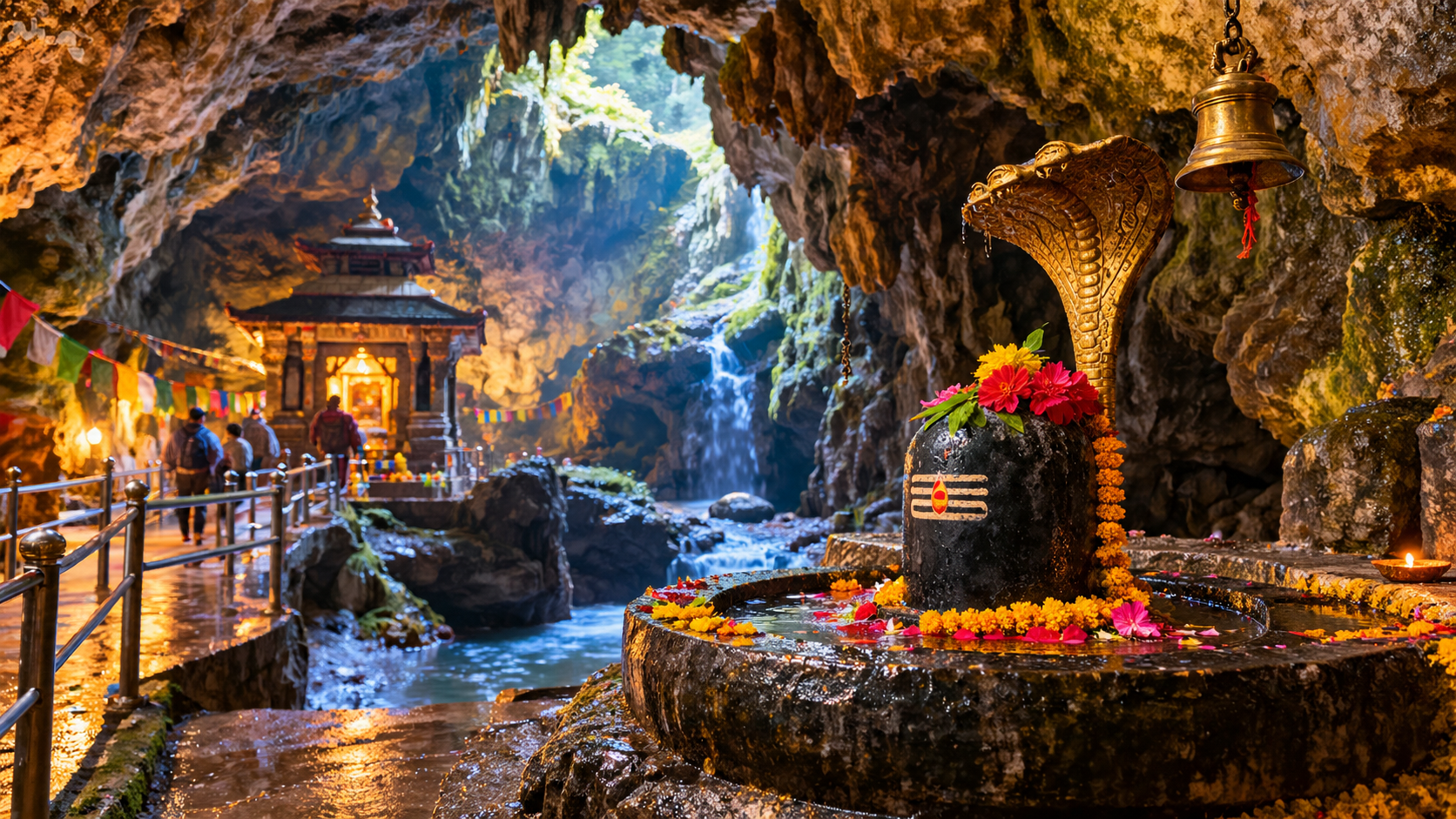
Just south of Pokhara’s city centre, directly opposite Davis Falls, a hillside cave holds one of the region’s more unusual pilgrimage sites. Gupteshwar Mahadev Cave extends more than two kilometres into the rock and contains a series of Hindu shrines — centred on a naturally formed Shiva lingam — making it both a religious destination and a geological one.
How the Cave Was Found
The cave’s name translates roughly as “the hidden lord” (gupta means hidden or secret in Sanskrit; Mahadev is a name for Shiva). Local accounts describe its discovery in the 16th century, when a group of young men clearing undergrowth on the hillside broke through into the cave’s entrance.
Inside, they found what appeared to be a naturally formed phallic stone — interpreted as a swayambhu Shiva lingam, meaning one that manifested spontaneously rather than being carved or placed. The discovery prompted the site to be treated as sacred. The cave remained a local pilgrimage destination for centuries before formal development. The main entrance structure was built in 1991, and a consecration ceremony for the idol took place in 1992.
The Cave and Its Shrines
The cave stretches 2,057 metres according to measurements recorded by scientific expeditions (including a British Karst Research Expedition that studied the cave’s geology). It descends via a carved stone staircase from the entrance. The path winds through two main chambers.
The first and larger chamber contains the central Shiva shrine, as well as smaller shrines dedicated to Parvati (Shiva’s consort), Nageswara (the serpent deity), and Saraswati. Photography is prohibited inside this main shrine area; temple guards enforce the rule.
A second chamber, roughly 140 metres in from the first, has differently coloured cave walls and a further viewing platform. This section is sometimes closed during and immediately after the monsoon season (June–September) due to flooding risk.
Davis Falls Underground
One of the cave’s stranger sights comes near the end of the accessible passage. The Pardi Khola river, which drops dramatically at the nearby Davis Falls (known locally as Patale Chhango), continues underground after its fall — and the cave route eventually brings visitors close enough to see it. Standing at the viewing point, you can watch the river rushing through the rock far below you. The roar is audible well before you reach the ledge.
Davis Falls and Gupteshwar Cave are connected by this same water system, which is why visiting both on the same day makes geographical and practical sense.
Practical Information
| Detail | Information |
|---|---|
| Location | Chhorepatan, Pokhara-17 (opposite Davis Falls) |
| Entrance fee | – |
| Getting there | Taxi from Lakeside (~15 minutes); also reachable from Damside |
| Visit duration | 45 minutes to 1 hour |
| Photography | Permitted in most of the cave; banned at the main Shiva shrine |
| Monsoon access | Second chamber may close June–September |
Buying tickets: Purchase at the counter at the cave entrance before descending. Do not pay anyone approaching you on the road outside.
What to Bring
A headtorch: The cave uses small electric bulbs for lighting, but stretches between lights can be dark. A personal torch makes the visit significantly more comfortable.
Appropriate footwear: The stone steps and cave floor are wet in places from seeping groundwater and waterfall spray. Sandals and flat leather soles are slippery. Trainers or shoes with grip are strongly recommended.
Physical access note: The cave involves a staircase descent, uneven ground, and at least one section requiring a low crouch. It is not well suited for senior visitors, young children, or anyone with limited mobility.
Tips for Visitors
- Go on a weekday morning if you want to experience the cave as a religious site rather than a tourist queue.
- The souvenir stalls immediately outside the entrance tend to be overpriced. Better deals on similar items are available in Lakeside.
- Combine with Davis Falls (directly across the road), the Tibetan settlement of Tashi Ling, and the World Peace Stupa for a full half-day in the southern part of the city.
- Dress modestly for the shrine sections: covered shoulders and knees.